

– 29 January 2026 –
Obris | Insights will take a deeper dive into relevant topics to produce quality content to educate, stimulate your thinking and help you invest well.
Prediction Markets
Prediction markets have existed for millennia. They began in the 1500s – over five centuries ago – evolving from informal betting on papal elections, wars, treaties and royal successions to articulate and accurate forecasting by governments, investors and sports enthusiasts today.
Such market forecasting has exploded in the past several years as the age-old tech was modernized by blockchain technology.
We offer this Deep Dive to delve into prediction markets and how this ever-expanding set of tools may be useful to investors, and perhaps for those wanting to improve their odds on the betting floor.
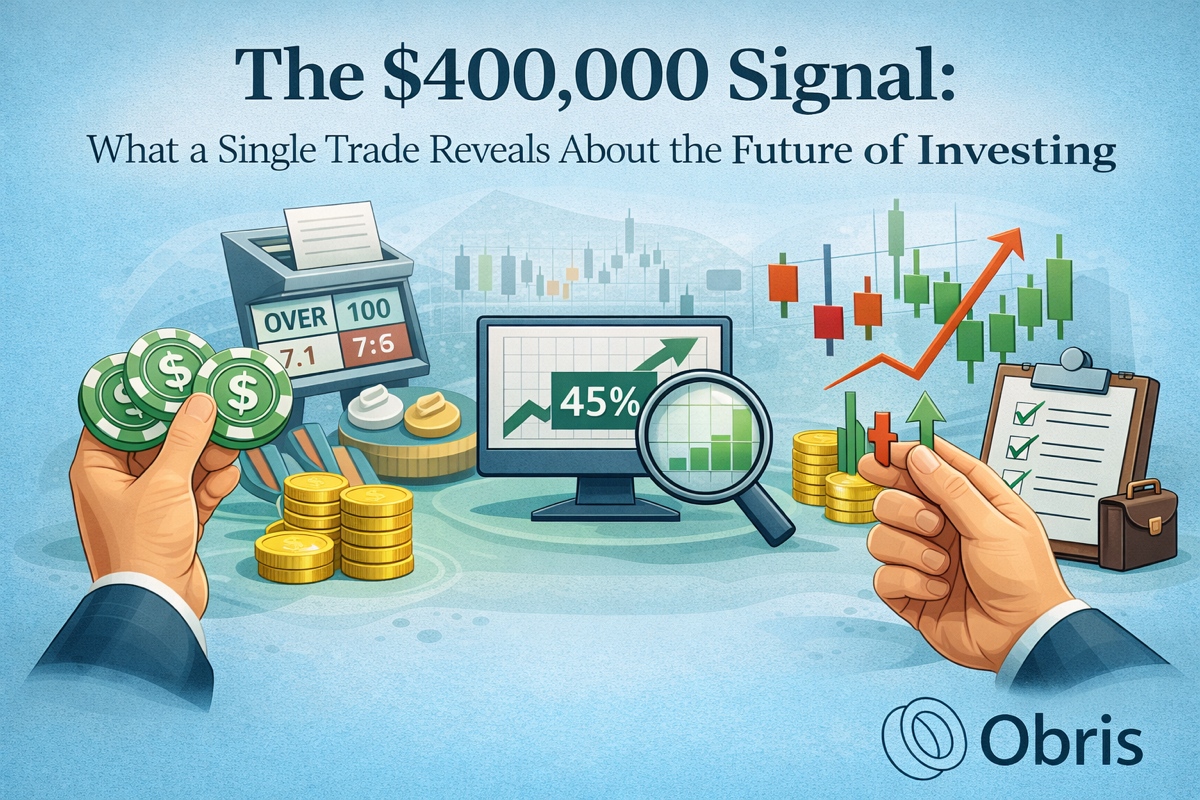
“Anonymous trader turned $30,000 into $400,000 profit
by predicting U.S. Capture of Maduro.”
On January 3, the Wall Street Journal reported that U.S. forces had captured Venezuelan President Nicolás Maduro. Beneath that headline ran a smaller one: an anonymous trader turned roughly $30,000 into more than $400,000 by predicting it. The trade took place on Polymarket, a crypto‑based prediction market where participants buy and sell contracts tied to specific, verifiable events.
The story was notable not because someone made a spectacular wager, but because a market—open to anyone willing to risk capital—had priced a geopolitical outcome before it became consensus news. While most observers focused on Maduro’s fate, I was fixated on the mechanism that surfaced the signal: a market that absorbed fragmented information, private conviction, and evolving facts into a single, continuously updated probability.
With that lens in mind, here is what prediction markets are and how they work in practice.
Prediction markets are financial tools that use market prices
to forecast the likelihood of future events by rewarding accurate
beliefs and penalizing wrong ones.
Prediction Markets
Prediction markets are marketplaces where people buy and sell contracts that pay out based on the outcome of a future event. Prices in these markets reflect the collective belief about how likely that event will occur.
Markets exist for politics, economics, business, science and technology, sports and entertainment.
In simple terms, each contract is tied to a specific, verifiable outcome – i.e., will the U.S. invade Venezuela and capture Maduro on January 3, 2026. If the event happens, the contract pays holders $1. If it comes to pass, the payout is $0. The current price of the contract demonstrates what the collective market thinks will be the outcome. $.30 gives a 30% chance that the event will occur.
Step by Step
- A market is created – example: Will the U.S. annex Greenland by March 30, 2026?
- Traders take positions – If you think yes, you buy “Yes” shares. If you think no, you buy “No” shares (or sell yes shares).
- Price movement –The market depends on information. As new information arrives – whether facts, data, news or rumors – traders update their positions. Prices rise and fall to reflect the changing probabilities.
- Resolution – On the day of reckoning – in this instance, March 30 – the contract settles. The payout for winning shares is $1. The payout for losing shares is $0.
This “wisdom of crowds” effect is why prediction markets are
sometimes more accurate than polls or expert forecasts.
Prediction markets offer surprisingly accurate results (most of the time). They combine public data, expert knowledge and private insights. They also incentivize accurate disclosure – people are putting money at risk.
The most valuable feature is that they are dynamic. Juxtaposed against surveys, reports and other forms of due diligence, prices adjust instantly as new information emerges.
Likewise, prediction markets offer certainty – not vague statements such as “likely” or “unlikely,” producing numerical probability.
Unlike polls, expert forecasts, or traditional research reports—which are episodic, narrative, and slow to update—prediction markets translate new information into prices immediately, revealing not just what people think, but how strongly they believe it.
Prediction markets are used in sports betting by turning game outcomes
into tradable contracts whose prices reflect the crowd’s assessed probability
of each result. Structurally they resemble betting, but economically they behave
more like financial markets.
Sports Betting: A Familiar Analogy
Sports provide a useful analogy for how prediction markets work.
A close friend of mine is an exceptional sports bettor—not because he guesses well, but because he synthesizes vast amounts of data, contextual factors, and experience into probabilistic judgments. Injuries, matchups, form, timing, weather—all of it feeds into his view of likely outcomes.
Prediction markets formalize that same process. Instead of relying on a single analyst, they aggregate the beliefs of thousands of participants, each risking capital based on their own information and conviction. Game outcomes become tradable contracts whose prices reflect the crowd’s assessed probability of each result.
Structurally, these markets resemble betting. Economically, they behave more like financial markets—allowing participants to trade probabilities, not place fixed wagers. In doing so, they often generate more efficient odds than traditional sportsbooks and adapt faster as new information emerges.
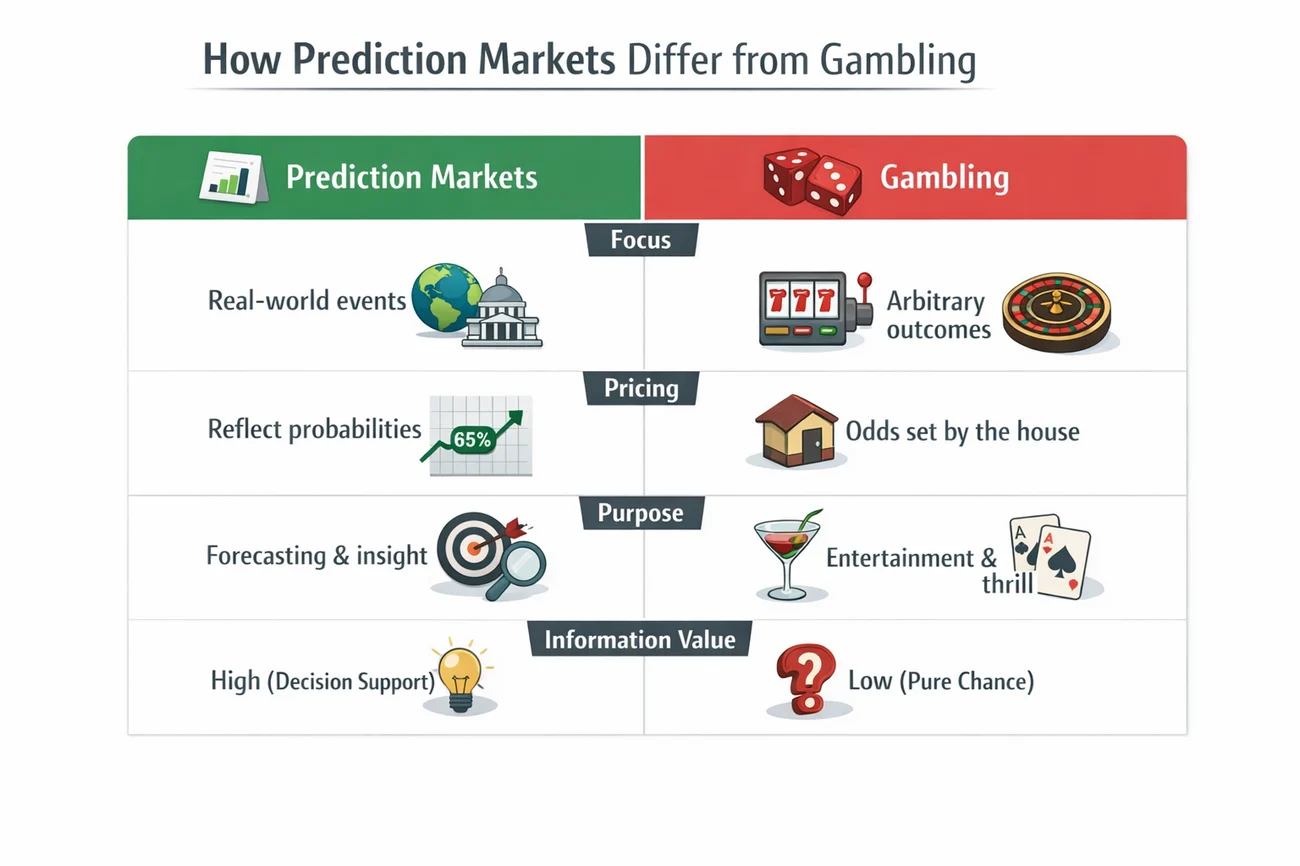
Treat prediction markets as signals, not instructions.
The utilization of prediction markets in sports betting has experienced exponential growth in recent years. Since early 2024, the market grew from USD $100 million to $13 billion by the end of 2025.
According to Sportsbook Advisor, Kalshi and Polymarket both quickly added markets tied to sports outcomes like the U.S. Superbowl, FIFA World Cup and professional league futures.
Governments: Why They Watch—and Worry
Governments study prediction markets for the same reason investors do: they can surface dispersed information quickly and translate it into probabilistic signals. That’s attractive for policy planning (e.g., gauging election odds, conflict risk, disease spread, or policy‑change timing), procurement, and crisis management—areas where traditional intelligence can be slow, siloed, or biased.
At the same time, governments worry about the optics and the incentives. Markets that “price” sensitive events—terror attacks, leadership changes, sanctions, or military action—can look like they’re monetizing national security, even when the real value is informational.
Legal and regulatory treatment varies across jurisdictions, which shapes liquidity and depth; thin, fragmented venues are more prone to noise and short‑term distortions.
For investors, the takeaway is practical: treat government‑related markets as early‑warning indicators, not verdicts. Focus on changes in implied probabilities around key dates (hearings, central‑bank meetings, court rulings, summit deadlines), and map those moves to exposure.
When policy‑sensitive markets lurch, ask what new information officials, insiders, or specialists might be reacting to? — then validate with primary research, local counsel, and scenario analysis.
In short: governments use these markets because they reveal pressure points in real time; they fear them because transparency can constrain policy flexibility. Investors can use that tension to their advantage—listening for signals, pricing the risk, and acting with discipline.
The house always wins!
Our discipline is to treat prediction markets not as an alternative to fundamental research or local expertise, but as a real‑time overlay—one that stress‑tests assumptions, highlights timing risk, and exposes where conventional research may be lagging or conflicted.
Marvin and I are not prone to gambling. We much prefer to stack the odds in our favor, to leave little room to variables and to carefully and thoroughly diminish the potential to fail. This plays out well for our members who invest in Obris deals in that we structure deals in their favor.
Prediction markets have become a phenomenal tool in the world of investing.
When we invest in a company, we are not betting that the company will succeed. Historically, we deploy our finance team to carry out thorough and invasive due diligence.
Before we commit to a prospective portfolio company, we dig deep and search wide to develop a model “prediction” for how we will “win” –how we will exit the company with a multiple X gain within a reasonable timeframe (typically 3-5 years).
Prediction markets may be used to accurately and dynamically quantify risks – political, regulatory, geographical, even environmental.
This is even more useful when access to traditional forms of data are limited or unavailable. For example, this has greatly enhanced how I assess potential opportunities in emerging and frontier markets where data is often sparse.
Of course, any market that claims to aggregate information efficiently also attracts scrutiny—especially around distortion or manipulation.
Prediction markets can be nudged—especially in thin or newly created contracts—when a concentrated trader pushes prices with visible size. That risk is most acute when liquidity is low, participation is narrow, or resolution criteria are ambiguous.
Yet because contracts settle to objective outcomes, distortions are typically short‑lived: a mispricing invites informed traders to take the other side, forcing prices back toward fundamentals as new information arrives.
Our discipline is practical: treat these markets as signals, not instructions or as places to bet.
When probabilities move sharply, ask what new information the market might be reacting to? —then cross‑check with your research, local intelligence, and scenario models. Even temporary dislocations can be informative, revealing where uncertainty or disagreement is rising most.
What does this mean for global investors?
Simply put – what does the best-informed crowd think is the probability of X?
The outcome does is not automatically binary – whether you either invest or not. Rather, prediction markets can be utilized to stress test investment models and scenarios. Scenarios can be rewritten to account for risk, timing, and other variables.
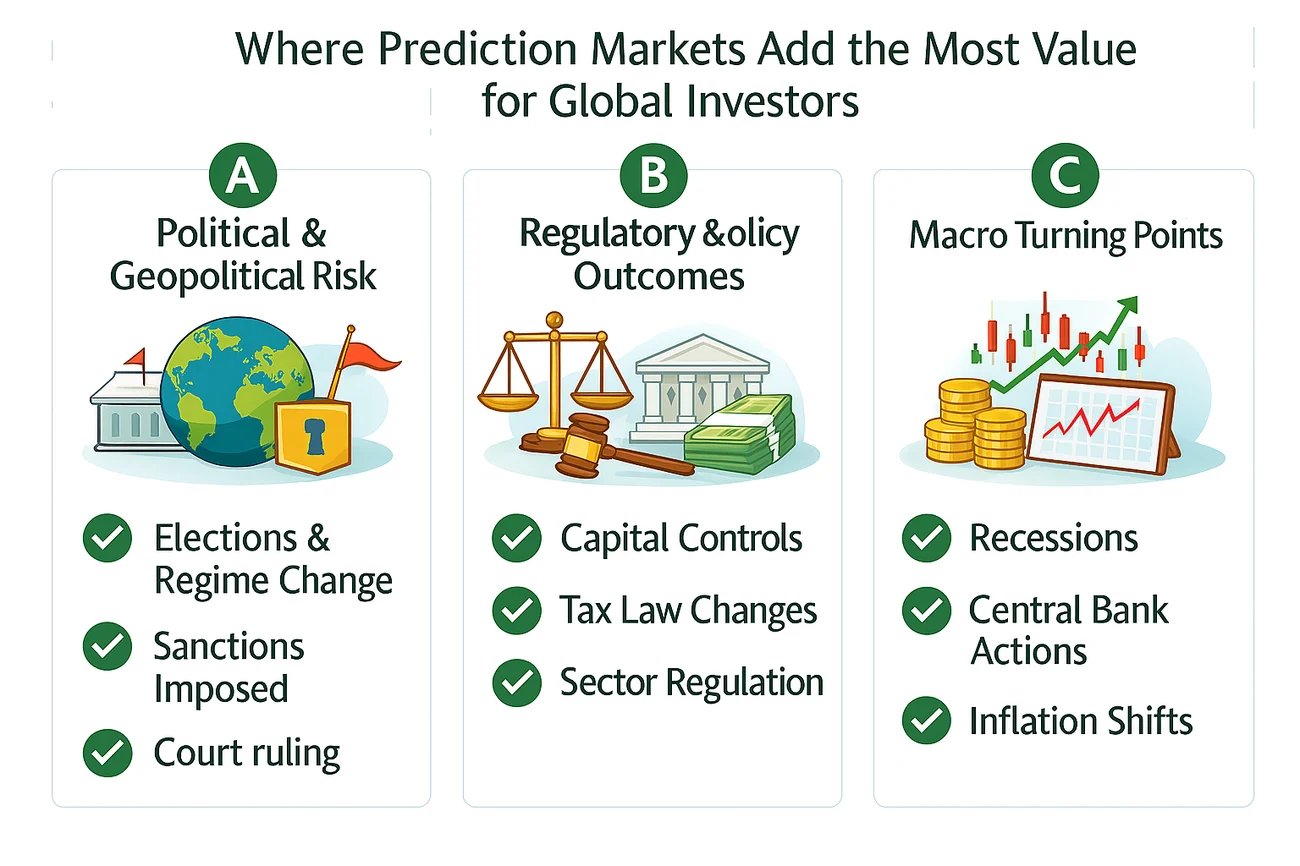
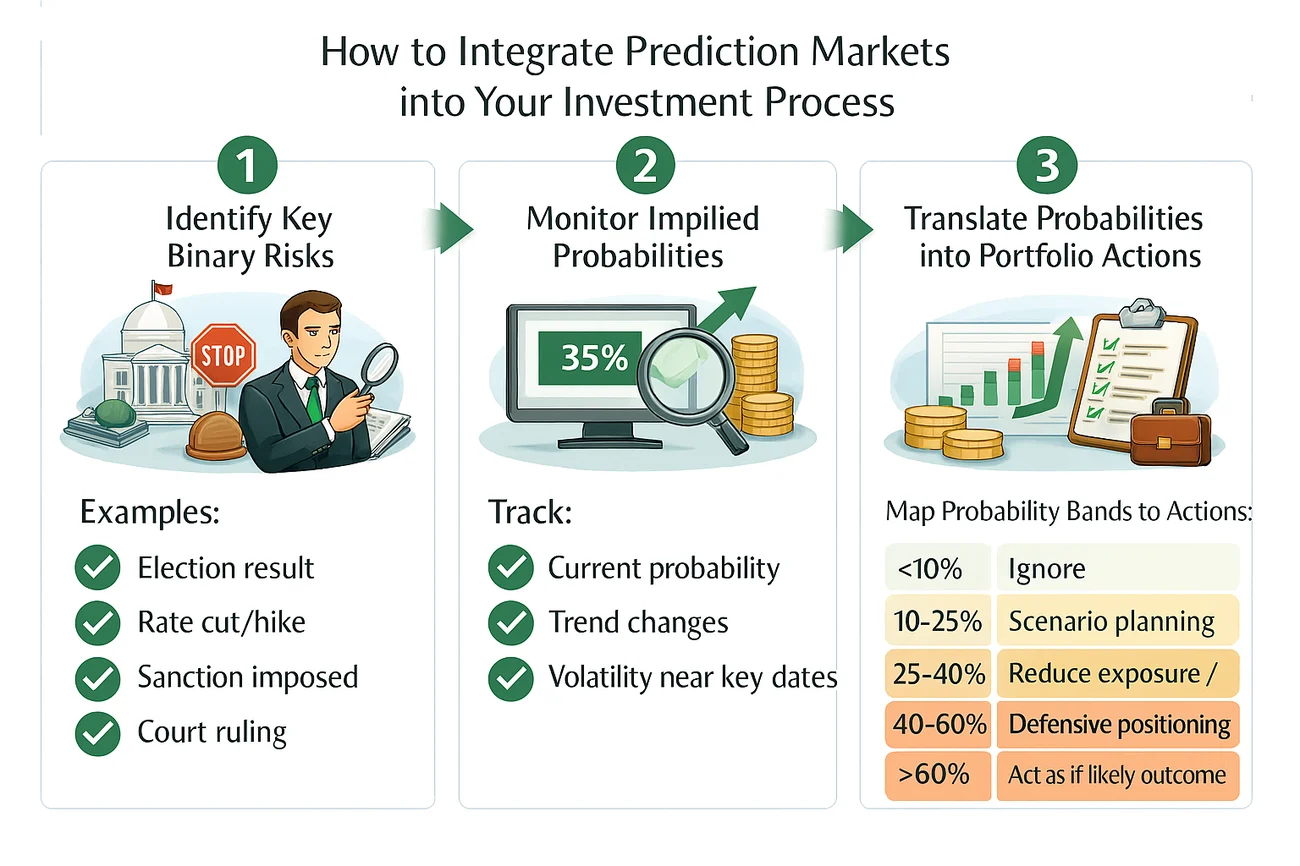
You are considering a new investment. After you read the pitch deck, do your research, consult with other prospective investors, and when possible consult with the principals – consider these steps:
Step 1: Identify key binary risks – For each major exposure, ask what single decision or event would materially change the outcome? Examples include court rulings, election results, geopolitical unrest, sanctions imposed, interest rate cuts or hikes…
Step 2: Monitor implied probabilities – What is the percentage likelihood of an event occurring? Track current probabilities, the direction trends are taking and volatility around key dates. Focus more on change than outcomes – A move from 15% → 30% often matters more than 60% → 65%.
Step 3: Translate probabilities into portfolio actions – this one requires discipline. You will want to create a structured decision-making framework that assigns specific, predetermined responses to different likelihood levels of an event occurring. It translates statistical uncertainty into concrete, actionable steps.
For example, we put a great deal of energy into planning Obris events. As we scan the world for forthcoming events, we often focus on exotic and promising markets for investment.
We are currently developing the next Obris Meet Up in Indonesia. In late April, we will gather in Jakarta and Bali.
Marvin has spent time in Indonesia, vetting several potential investments. One of our members lived there for decades while involved in Indonesia’s mining industry. Others have visited Jakarta and/or Bali. I have yet to step foot in this vast and diverse country of more than 17,000 islands.
As part of our initial investigation into Indonesia, I created a prediction market dashboard utilizing one of my favorite AI tools – it took two minutes to accomplish what has previously occupied hours of research.
I started by creating a macro level country and industry risk assessment. I then drilled into four key industries – mining, real estate, energy and technology. I can drill further. I can also have the AI tool update the dashboard on a regular basis to ensure that the data is dynamic.
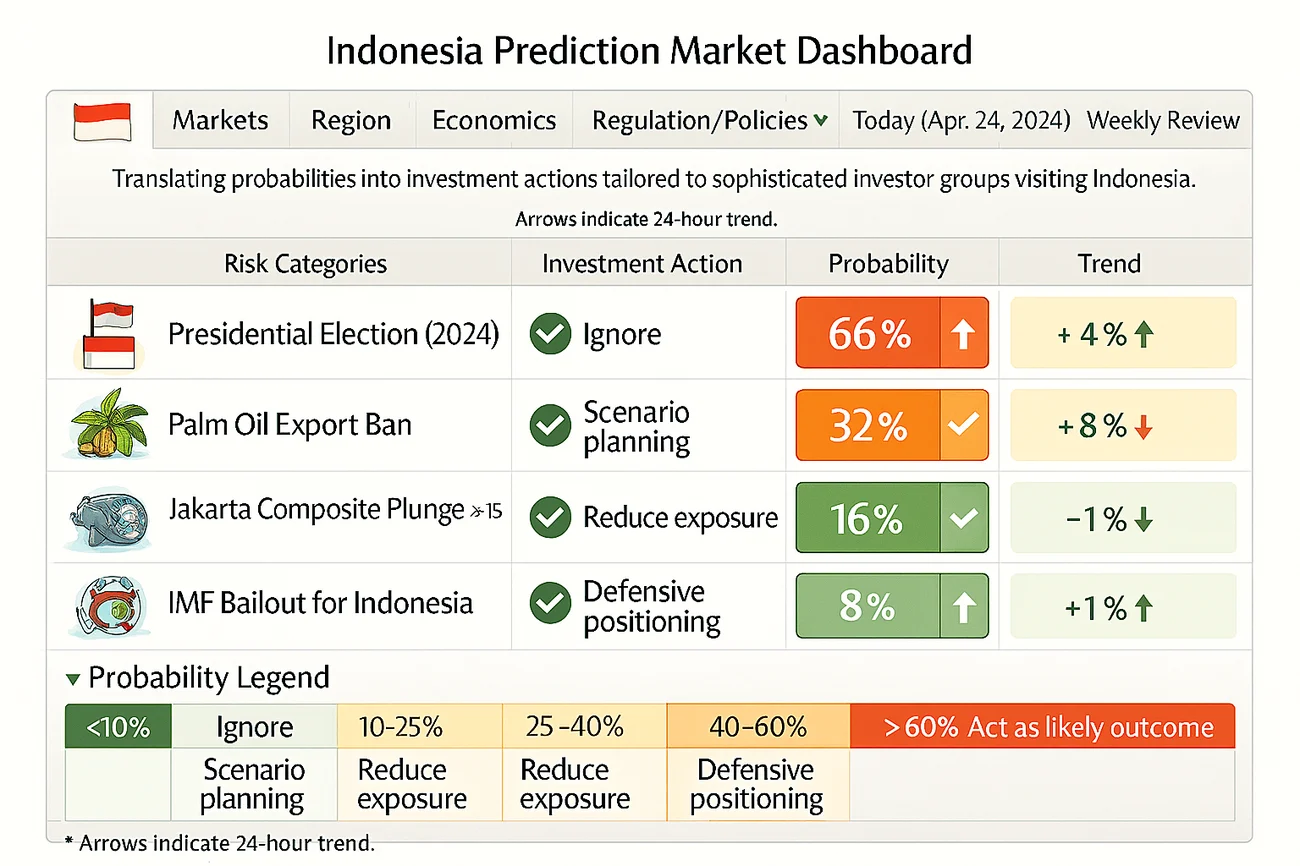
How will this be useful for the Obris Meet Up? We will make the dashboards available to participants well in advance of the event – as a primer on Indonesia, and for investors to launch their own deeper dives into sectors that pique their interest.
On the ground in Jakarta and Bali, the dashboards will enhance our experience. We will use then to frame questions, to evaluate and compare to our own experiences, and to challenge preconceived hypotheses.
What do my Indonesia prediction market dashboards conclude?
Indonesia is investable today — but returns are driven by
sector-specific policy dynamics, not macro direction.
Prediction markets suggest Indonesia is investable across all four sectors — but only if investors price regulatory evolution, not political collapse.
Look for yourself. You will find the Indonesia – Prediction Markets Informed Dossier I created here.
Conclusion: Seeing the Future—Clearly, Not Perfectly
Prediction markets will not tell you what to do. They will not replace due diligence, local expertise, or hard-earned judgment. And they will not eliminate risk.
But they do something increasingly rare in global investing: they convert uncertainty into a price.
When an informed crowd puts capital at risk, probabilities change in real time—absorbing facts, leaks, incentives, and intuition faster than reports, polls, or policy briefings ever could.
For investors operating across borders, regulatory regimes, and imperfect information environments, that signal is invaluable.
The lesson of the Polymarket trade was not that someone made a spectacular wager. It was that markets—when structured correctly—can surface truth before consensus forms. That same dynamic can help investors stress-test assumptions, reweight scenarios, and identify risks that traditional research overlooks or encounters too late.
Used wisely, prediction markets are not a venue for speculation. They are a lens—a way to ask better questions about timing, probability, and exposure in an increasingly complex world.
For global investors, the opportunity is not to bet on outcomes, but to listen to what the best-informed crowd is already telling you—and to act before everyone else catches up.

|
Notice: This investment material relates to an offer only available to Eligible and Wholesale investors under the Financial Markets Conduct Act 2013 (FMCA). The information contained in this document should be used as general information only It does not take into account the objectives, financial situation, or needs of any investor, or purport to be comprehensive or constitute investment guidance and should not be relied upon as such. You may consider consulting a registered financial adviser to help you form your own opinion of the information, and whether the information is suitable for your individual objectives and needs as an investor. You should consult appropriate registered professionals on any legal, taxation, and accounting implications of making an investment via Obris and its subsidiaries and affiliates. Investments are risky and while there is potential upside return, investors can also lose some or all their investment.
|