

– 27 August 2025 –
The BBC recently published an Exposé of the 10 most livable cities in 2025. The article is based on an annual study by the Economist Intelligence Unit (EIU), an affiliate of the publisher of the Economist magazine.
Alongside #1 – Copenhagen most of the top 10 cities are in Europe (5) and Australasia (3). Two are in Asia, and only one is in North America.
Apart from Adelaide, Australia I have spent time in each the cities and have lived in two of them. While each is a great city, the EIU list left me questioning how are these are the best of the best? And for whom are these most livable? What other criteria should we consider?
In my own analysis of the chosen 10, I concluded that I along with many of our readers may have more nuanced criteria for identifying what makes a “place” livable. Where we live is a choice; why not choose the best, or more specifically the best for us.
That is the theme for this issue of the Global Investor. What are your criteria for choosing where you live today, and where you may want to live in the future?
Before you jump into the article below, note that early bird pricing for the Mumbai Obris Investor Meet Up will end on August 31. Click on the button below to register.

An increasingly common point of discussion with friends and acquaintances, and within the Obris community is what is your ideal place to live?
Some of my friends have found that perfect place for them. Some have settled in Panama, Thailand, Spain, even Idaho in the U.S. Some have started making plans to relocate.
Others – like me – utilize frequent travel around the world to explore places where we may want to live. We supplement such travel with ongoing research about geography, climate, geopolitics, taxes… matters that are important to high-net-worth individuals.
Global Livability Index 2025: Top 10
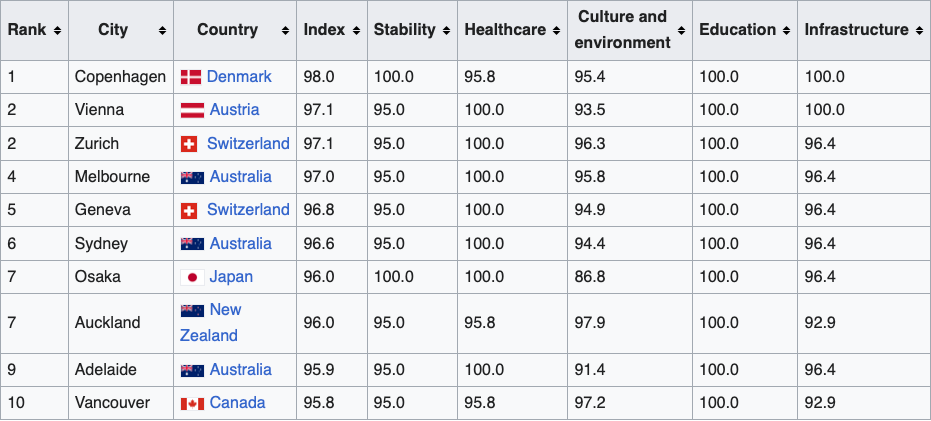
The EIU Index
I was fortunate to live in #10 – Vancouver for two years while I attended graduate school at the University of British Columbia. Even for a student with a limited budget, Vancouver was a great place to live.
Each morning, I made my coffee in our kitchen that overlooked three beautiful snowcapped peaks north of the City. I rode my mountain bike to and from the university throughout the year rain or shine (mostly drizzle). I spent most afternoons at my favorite library on campus; my preferred desk had a peekaboo view of the ocean which made hours of studying all the more palatable.
My friends and I often took day trips to Whistler to ski and trips to the nearby islands to relax. Summers were amazing. As a U.S. citizen, my dollars went a long, long way.
As it does today, Canada’s third largest city offered ample amenities to satisfy almost anyone’s desires.
Would I live there today? Probably not considering my personal criteria for livability.
The EIU Index produces their ranking base on five categories. These include stability (25%), healthcare (20%), culture & environment (25%), education (10%), infrastructure (20%).
Each category is broken down into several subcategories that are identified as “Indicators.” You may find the complete report with a detailed breakdown and analysis on the EIU website (here).
For reference, here are two of the categories with their indicators:
A Nuanced Approach to Livability
Each of the EIU categories and indicators are valid and worthwhile considerations. I cannot imagine living in a city or region that lacks such infrastructure.
Through their annual assessment, the EIU defines and illuminates conditions for those of us who choose to live in our world’s most populated cities. My prepper friends and those who choose to live at least partially off the grid have an even more nuanced set of requirements.
Quality and accessible healthcare is, for example, a must. It is not just needing quality care as we age. Rather, it is crucial for each of us to utilize the best of medicine to maintain and improve our health with a mindset toward thriving well into the future.
Global Investor readers may recall that I increasingly look to Southeast Asia for my healthcare. I have an established presence at Gleneagles Hospital in Georgetown, Penang where I undergo an annual invasive health screening of blood tests, ultrasounds, stress test and full body scan.
At the end of the day of tests, a physician analyses and reports their findings to me. This feedback alone is priceless as I seek to live a healthy life.
As a patient of Gleneagles, I can go to any Gleneagles throughout much of Asia. While the minimal cost for private healthcare in the region is appealing, I also appreciate that I don’t have to wait for tests.
I am due for the long-dreaded colonoscopy on my birthday next year. In the US where I am required to maintain outrageously priced medical insurance, I will need to schedule a colonoscopy at least nine months in advance. At Gleneagles, I need only to schedule weeks ahead. And the cost will be significantly less than what I will pay out of pocket with my health insurance plan.
Expanding the Criteria
What additional criteria do you and I need to consider? Your ideal or essential “livability” and mine may be different, but I believe that they will mostly overlap. Here are several to consider.
Geopolitics Beyond the City
We start every Investor Meet Up with a presentation on regional geopolitics. We undertake similar research when we begin due diligence on a prospective new investment offering for Obris members. How stable is the given country, and the region beyond?
Australia, New Zealand and Singapore are geopolitically stable – mostly. Can we say the same for North America and Western Europe where most of the EIU top ten cities exist? No – but we will save a deeper dive for a future newsletter.
Immigration Policy & Residency Pathways
How easy is it to obtain a visa, residency or citizenship? While most of us can easily secure a 30-day visitor visa to most countries, making a new country our home requires much more. If residency is feasible, what are the hoops that one must jump through and how long will it take?
Taxation & Governance
Taxation is a significant concern wherever we live.
Let’s say that I decide to move to #1 Copenhagen. Denmark’s capital is also ranked the world’s happiest city according to the Institute for Quality of Life. According to the BBC article,
Denmark sounds great to live, but what about taxation if I choose to become a resident. I am considered a resident if I have a home in Denmark or live there for at least six months of the year. As a resident, I will be subject to taxation on my worldwide income. Even if I do not work in Copenhagen, I will still pay taxes on my income from elsewhere.
Georgetown on the island of Penang in Malaysia is one of my favorite cities. It ranks high on my personal livability index. The region is beautiful. Amenities such as restaurants, parks, availability of quality products, walkability and stability make the city highly livable. Penang is easily accessible to global gateways including Kuala Lumpur, Singapore and Bangkok. Aside from the never ending heat, it is paradise.
What about paying taxes? If I become a resident of Penang, I will be taxed only on my local income. This excludes my income outside of Malaysia. If I do not have any Malaysian income, I will not be taxed in Malaysia.
I have told you about Malaysia’s MM2H (Malaysia My 2nd Home) visa program. The application process is straight-forward. The required investment or local deposit of funds is comparatively small. Overall, the hurdles to secure residency are far from onerous.
Note that this visa scheme is specific to the state of Penang. Malaysia overall and other states within Malaysia have differing requirements.
Other countries also offer comparable tax incentives for expats who choose make their country home.
Resilience to Global Shocks
I have heard rumor that if the northern hemisphere is destroyed by nuclear disaster, fallout in the southern hemisphere will be comparatively minimal. While I do not believe this will take place, it is a worthwhile consideration.
Only Singapore, Auckland, Melbourne and Adelade will remain among the top ten. Fortunately, there are a host of other cities and regions across the Southern Hemisphere that may offer the lifestyle you want to thrive.
One of my essential tests of a country’s resiliency is to ascertain how the government handled the global pandemic. For those that took draconian measures, is the government still in power? What is the likelihood that they will behave any differently in the future?
Macroeconomic Stability & Growth Prospects
What does the region offer for the long term? We are currently affording considerable attention to India – the fastest growing economy in the world. We will explore India’s stability and growth prospects during the Obris Investor Meet Up in Mumbai in a few months.
It is important to consider the likely future livability of any city or region we may want to call home.
Social Inclusion
How welcome are immigrants, minorities and people of different cultures? What you experience walking down the street, shopping in local malls and exploring regional nature is just as important as how you are treated by the local government.
Maintaining One’s Expected Lifestyle
We all have expectations for how we live. Will we be able to maintain the standard of living to which we are accustomed? Does the local work force include skilled laborers to make improvements to our homes and those to clean, care for children and maintain our properties? Are the amenities we require readily available?
Affordability and Cost of Living
This final topic is a huge one. Even the most beautiful and safe city can feel unlivable if housing, food, or services are prohibitively expensive.
For most of us paying more is not a matter of life and death. However, we want to choose how we spend our money. The top 10 Livable cities have high costs of living. I would rather live in a city where my living expenses stretch further. That better affords me the freedom to deploy my wealth as I choose.
While our additional categories are far from exhaustive, they give perspective to consider as you choose where to live and what is most livable to you.
If you love where you live, let us know and tell us why.