

We love the returns that curated investments bring – our goal is typically 3-5x in the same number of years. Such investments often involve higher risk, and the results can be binary – they either exit well or they exit at zero.
A smart investor with a diverse portfolio often balances higher risk curated investments with stable, secure, passive investments that may offer annual yield or consistent capital gain.
This issue of the Global Investor focuses on passive investing with a spotlight on our own High Yield Debt Fund.
“If you don’t find a way to make money while you sleep,
you will work until the day you die.” — Warren Buffett
Marvin Yee
Partner at Obris by Crown Private
Founder, Crown Capital
Passive income exists in many shapes and sizes. At its core, passive income is money earned with minimal daily effort, though it requires significant upfront investment in the form of time, capital and other resources.
It is often associated with long-term cash flow – such as rental income, dividends and royalties.
At Obris, passive income correlates with freedom – it is money that is working for you, thus freeing you to do what you love.
Our signature passive income product – the Crown High Yield Debt Fund (Debt Fund) – works hard for our members. Since its inception nearly eight years ago, the Debt Fund has produced a cumulative average annual gross return of close to 20%.
For comparison, the U.S. S&P 500 produces ~10% annually. Most REITs (real estate) average ~4.8% annual yield. The dividends of a typical stock portfolio average 8-12% annual returns.
While the Debt Fund does not produce returns on par with the curated deals in our investment portfolio, it offers consistent outsized returns via-a-vis it’s relatively conservative risk profile.
Non-traditional Credit
Like many entrepreneurs, I bootstrapped my first business with my life savings, 90-day work weeks and ample sweat equity.
I had no equity to speak of and certainly no hard assets. I also maxed out all my credit cards. American Express had a hitman looking for me, so did Discovery and at least one of the local stores from which I purchased for my business.
While I confess this part of my story with chagrin, it taught me a great deal about running a business, managing cash flow and perhaps most importantly, the relationship between risk, reward and how far you’re willing to go to back yourself.
The only avenue for funding for me was short term equipment financiers – those offering interest rates starting from 28% pa. For me, short-term pain was worth the risk. I used credit to ensure that the new earnings I bought and grew were enough to cover my interest cost plus more.
Eventually my finance terms matured, and I was able to breathe a sigh of relief as the ‘short term pain’ ended.
The most important lesson I learnt was that debt – even expensive debt – is not bad if you know how to use it productively. It was certainly better than nothing at all – without such expensive financing, I would have never built my business.
Expensive debt also built resilience. While we would prefer cheap debt as one may get from the bank, the reality is that expensive debt builds resilience and focuses you to learn lessons quickly.
The best time to borrow money from the bank is when you don’t need it. Banks don’t loan during a tough economic climate; it’s simply how their risk profile works. Entrepreneurs will know that it is in tough times that opportunity exist.
The reality is that when economic cycles get tough, and they always do, easy equity (or easy credit for that matter), dries up very quickly.
As such, second-tier financiers such as private credit issuers exist for this very purpose.
Why Private Credit Exists at All
Private credit exists for businesses that do not fit a regular template on what banks would normally lend.
Banks are subject to numerous regulatory capital requirements, risk weighting rules, and other constraints across their entire business that are not lending related. This makes non-conventional loans unattractive for traditional banks, even when loans are well secured.
As a result, many strong businesses with real assets and clear exit paths are underserved—not because they have poor credit, but because they do not fit standardized lending models.
Private credit fills this gap by focusing on loan structure, security, and downside protection rather than a templated exercise.
For investors, this creates the opportunity to earn higher yields from structured loans operating outside the constraints of the traditional banking system.
Private Credit is not Risk-Free
Of course, private credit is not risk free. The primary risks are liquidity, potential for borrower default, and asset valuation timing.
Our approach to lending is designed specifically to manage these risks. We do so through short loan duration, conservative security coverage, and active control over origination and enforcement of the loan.
The Genesis of the Crown High Yield Debt Fund
Debt can be a lifeline to a business and enough debt, if properly utilised is sufficient to buy a business out of trouble and into opportunity.
It is however imperative to hedge against financial loss. Above market returns frequently correlate with higher risk and our task is to ensure that the return from our debt is asymmetric to the risk.
The Crown office sits in Auckland – at the centre of New Zealand’s commerce. We are part of the financial hub of activity that powers much of the country’s economy. We are surrounded by companies that depend on funding, including many companies that are overlooked by the traditional banks.
So became the genesis of the Crown High Yield Debt Fund.
We created the Debt Fund to fill this gap in the market – to provide lending to several underserved niches in New Zealand’s financial infrastructure. As our New Zealand market has grown, we have also crossed the Tasman Sea to serve a much larger market in Australia.
The Debt Fund supplies capital to our bridge lending business. CFS Bridge Finance processes and manages commercial loans in this sector. It is all kept in-house at Crown.
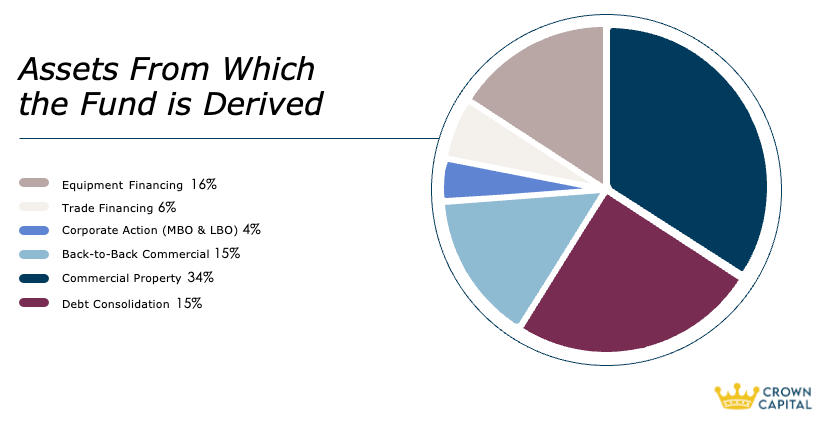
Our commercial loans – typically 3-12 months in duration – provide funding in four key areas:
Operating Expenses – For many companies, cash flow ebbs and flows. Some months are great, while others may bring in minimal cash to keep up with the bills.
We provide a “boost” with our debt facility to even out between good and bad months. As the client pays off their loan over a series of months, their better trading months compensate for the leaner months. While rates are not the same as long-term lending, the borrower may quickly exit their loan when internal conditions improve.
Business Expansion – It is all too common for businesses to need short-term capital to expand. This may be a developer starting a new commercial or residential project, an importer bringing in new products from overseas or an industrial producer buying equipment to expand their production.
With each, funding from Crown is used to pay for the capital costs of business expansion.
Specific Projects – Companies want to embark on new projects that they know will be a win for them once complete. They do so even when they do not have the working capital to pay interest and principal along the way.
One example is multi-family housing developers who will not be able to repay their loan until their product – often townhouses – begin to sell. These companies need a loan that compounds with no payment until the end of the term when the balloon payment is due.
Leveraged & Management Buyouts – Crown supports business with acquisition financing thus creating more successful businesses via mergers as well as succession planning for management buyouts.
Why Companies Choose Us vs. the Banks
Many thriving businesses in New Zealand and Australia have come to rely on short-term lending from Crown. Aside from being thwarted by traditional lending, qualified companies consider us their preferred funding provider. They do so for several reasons:
Speed – We are quicker to loan and the process is less cumbersome than banks which require building an entire understanding of the business, rather than just the assets in which the security lies.
Underlying Security – We focus more on the value of the underlying security than the servicing ability. Servicing ability is a lender’s assessment of a borrower’s capacity to meet regular loan repayments based on income, expenses and existing debt. While serviceability is important, our weighting is heavier on the borrower’s assets that we hold as security for the loan.
Commercial Lending – We only do commercial lending. Personal lending is often more onerous and can be politically charged. Unlike banks which need to follow the Consumer Credit Contracts and Finance Act due to the personal lending they do, we operate only within the less restrictive confines of the Fair-Trading Act which governs commercial lending.
We have provided bridge financing to several of our portfolio companies including Cooks Coffee Company, Sealegs Amphibious Boats and Manuka Biosciences – all solid companies that needed bridge funding beyond what the mainstream banks offered.
Why This Works
For our investors, the Debt Fund provides a low risk means to achieve above market returns. It is a relatively safe way to round out a more aggressive portfolio.
Security First, Always – Every loan is between 50% to 65% LVR (Loan-to-Value Ratio). A $500,000 loan for example would require the client to offer Crown first ranking security for at least $1M in tangible assets. This means there’s plenty of security left in the asset by the time the loan matures.
We focus less on projected cash flow and more on what we can control if things go wrong.
Short Duration = Lower Risk – Our typical loan duration is 3–12 months, not years. This dramatically reduces exposure to macro shocks, interest-rate cycles, and long-tail uncertainties.
Experience in Non-Traditional Credit – This fund was born from lived experience. We understand the borrower because we were the borrower. That perspective allows us to price risk accurately, move quickly, and structure loans banks simply cannot.
The Result
Creating the Debt Fund satiated my quest to establish a stalwart passive investment product – one that produces notable yield while still being able to provide a fair opportunity for entreprenuers to fund their businesses.
Through doing so, I proved that risk can be mitigated without compromising on returns. The proof is in the numbers. After 8 years of operations, we have yet to have non-performing loans, albeit we have had to restructure some facilities.
Proof is also in the satisfaction our investors experience knowing that their money is working hard for them while they sleep. Returns in the debt fund have ranged from the mid to high teens in interest per annum.
If you are interested to expand your portfolio with an investment in the Debt Fund, let us know. Click on the button below and we will send you some information on the fund.